


The “rear push (auxiliary push/assist)” system of a pipe bending machine is mainly divided into three types according to the driving method. Their core objective is to apply thrust from the tail of the pipe during bending, coordinating with the front-end pull bending to offset tensile stress and improve forming quality. However, their applicable scenarios and effects differ significantly.
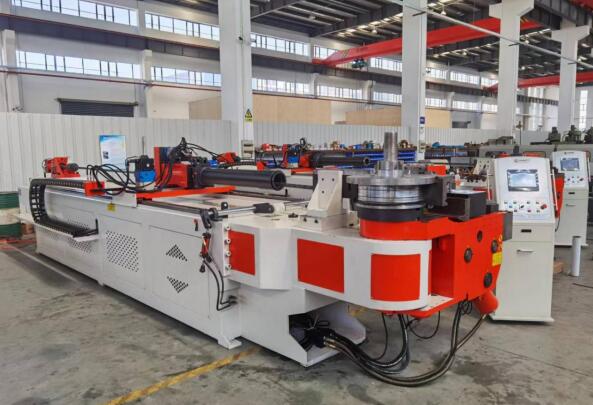
I. Three Main Forms of Rear Push in Pipe Bending Machines
- Hydraulic Rear Push (Most Common)
Driving Method: A hydraulic cylinder directly pushes the tail of the pipe; the thrust is adjustable and stable.
Main Functions:
- When bending thin-walled pipes or small bending radii (≤1.5D), prevents excessive thinning of the pipe wall and reduces ellipticity.
- Simultaneous pulling and bending at the front end and pushing at the rear end of the pipe allows for “pulling and feeding” of the pipe simultaneously, resulting in uniform force distribution and reduced springback.
- When bending long pipes, prevents sagging and shaking, improving stability.
Applicable Scenarios: Hydraulic pipe bending machines, heavy-duty pipe bending machines; suitable for carbon steel, stainless steel, and thick/thin-walled pipes.
- Servo Motor Rear Push (Servo Auxiliary Push)
Drive Method: Servo motor + ball screw drive, closed-loop control of thrust and speed, high precision, and fast response.
Main Functions:
- Precisely controls thrust and bending speed synchronously, suitable for high-precision, multi-segment bending, and complex trajectory pipes.
- Enables variable thrust control for different bending segments, solving the forming differences of different bending radii.
- Reduces pipe tail “trailing,” improving material utilization.
Applicable Scenarios: High-end CNC pipe bending machines, automotive/aerospace precision pipe processing.
- Mechanical Spring/Pneumatic Push (Simple Type, Less Commonly Used in Mainstream Industrial Machines)
- Drive Method: Spring or cylinder provides fixed thrust; simple structure and low cost.
Main Functions:
- Provides basic auxiliary thrust for easy bending of lightly loaded, small-diameter pipes.
- Prevents pipe from sliding backward during bending, maintaining positioning.
Applicable scenarios: Small pipe bending machines, manual/semi-automatic equipment, suitable for simple, low-precision bending needs.
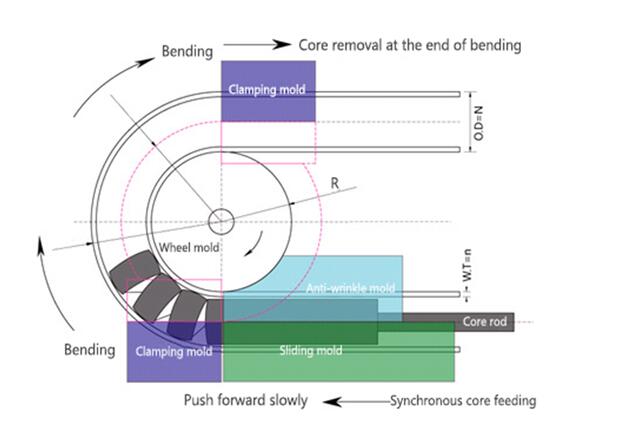
II. Main Functions
- Anti-flattening, anti-wrinkling, and anti-cracking: Especially for thin-walled pipes and small bending radii (1D–1.5D), the push-back mechanism counteracts tensile stress at the bend, controlling pipe wall thinning and ellipticity, preventing wrinkling on the inner side and cracking on the outer side.
- Improved precision and reduced springback: The push-back force and bending force are balanced, resulting in uniform stress on the pipe, accurate angles, rounded arcs, minimal springback, and good dimensional consistency.
- Reduced thinning rate: The outer wall of the pipe does not become excessively thinner during bending, resulting in more stable strength (e.g., automotive exhaust pipes, air conditioning pipes).
- Enables bending to smaller radii: Ordinary bending is difficult to achieve **≤1.5D**, but the push-back mechanism can stably produce a small 1D radius, suitable for compact piping designs.
- Adaptable to long pipes/large diameters: For long pipes with drooping ends and large diameters with high rigidity, the push-back mechanism assists in feeding, reducing vibration and making forming more stable.
- Reduced waste: Even short pieces at the end can be bent smoothly without leaving a long clamping section, saving material.
Summary: Ordinary pipe bending only pulls one end, making the pipe prone to flattening and wrinkling; push-bend bending involves pulling from the front and pushing from the back, the pipe is “pushed and bent,” the force is evenly distributed, resulting in a naturally round and precise bend.
III. Application Areas
- Automotive: Exhaust pipes, oil pipes, seat frames
- Bathroom Fixtures: Thin-walled stainless steel pipes
- Air Conditioning/Refrigeration: Small-radius copper pipes
- Furniture/Fitness Equipment: Multiple bends, long pipes
If you also need a suitable pipe bending machine, please feel free to consult Shanghai ANTISHICNC Machine. As a seasoned supplier of metal machining equipment, we have rich experience in mechanical equipment manufacturing and application, and can provide you with professional technical support.
Please send an email to: contact@antsmachine.com
For more product information, please visit: https://www.antsmachine.com/
Keywords: