


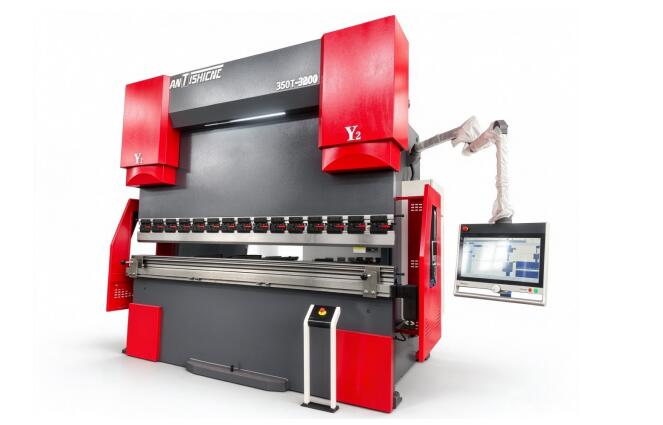
The core difference between a torsion-bar CNC press brake and an electro-hydraulic (electro-hydraulic servo) CNC press brake lies in the synchronization method:
Torsion-bar: Mechanical forced synchronization
Electro-hydraulic: Closed-loop synchronization using linear scales and servo-proportional valves
Below, we analyze the main differences between these two types of equipment across five aspects:
- Working Principle
Torsion-bar Bending Machine (Torsion-bar Synchronization)
A rigid torsion bar at the rear of the machine connects the linkage arms of the left and right cylinders, forcing them to move synchronously through a rigid mechanical connection; it lacks real-time position feedback and operates via open-loop control. Stroke positioning is managed internally by a lead screw and nut mechanism, meaning the left and right Y-axes cannot be adjusted independently.
Electro-hydraulic CNC Bending Machine (Electro-hydraulic Servo Synchronization)
Each cylinder is equipped with an independent electro-hydraulic proportional servo valve, and optical or magnetic linear scales are installed on both sides of the ram to monitor its position in real-time. The system detects any stroke discrepancy between the left and right sides and immediately adjusts the oil supply to dynamically correct the Y1/Y2 axes in a closed-loop manner, allowing for independent stroke control of each cylinder. Standard features include table deflection compensation (V-axis) to counteract the issue of center sagging when bending long workpieces.
- Precision and Off-Center Loading Capability
Torsion-bar: Repeatability is generally around ±0.05mm. Off-center loading performance is poor; inconsistent bending angles at the ends can easily occur when processing long sheets or applying force to only one side. Mechanical wear on the torsion bar over time leads to gradually declining precision, requiring repeated manual machine adjustments. Suitable for standard door panels, simple sheet metal parts, and products with loose angle tolerance requirements.
Electro-hydraulic servo: Repeat positioning accuracy can reach ±0.01–0.02mm. Strong resistance to off-center loading ensures consistent bending angles across the entire length of the sheet—ideal for long sheets, stainless steel, and precision enclosures or cabinets. Automatic deflection compensation corrects mid-span deformation, ensuring stable precision during mass production. Supports graphical programming and multi-stage sequential bending.
- Price, Maintenance, and Costs
Torsion-bar: Lower purchase price; simple hydraulic valve assembly; universal spare parts; easy and inexpensive maintenance. Disadvantages: Numerous mechanical transmission components; the torsion bar and swing arms are prone to wear over long-term use.
Electro-hydraulic: Significantly higher machine price; servo valves and linear scales are precision components requiring rigorous maintenance and expensive spare parts; strict requirements for hydraulic oil cleanliness, as contaminated oil can easily cause servo valve malfunctions.
- Speed and Operational Characteristics
Torsion-bar: When changing angles, the screw rod inside the cylinder must rotate to adjust the stroke; there is a time lag during step transitions, resulting in lower efficiency for continuous multi-step bending; pressure settings often require manual adjustment.
Electro-hydraulic: Y1 and Y2 axes can be independently controlled in real-time; step transitions are rapid, leading to higher efficiency in continuous bending; pressure is automatically calculated after inputting material thickness and length.
- Quick Selection Guide
Choose Torsion-bar CNC: Suitable for limited budgets, simple sheet metal work, thin sheets, small batch sizes, and applications with moderate precision requirements (e.g., standard door panels, shelving, simple frames); an entry-level model for small and medium-sized processing plants.
Choose Electro-hydraulic Servo: Suitable for precision sheet metal work, stainless steel, long sheets, enclosures and cabinets, multi-step bending, and stable high-volume production; ideal when there are strict requirements for bending angles and straightness.
For details, please refer to the brief comparison table below:
| Type | Torsion-bar CNC press brake | Electro-hydraulic CNC press brake |
| Synchronization method | Mechanical forced synchronization via torsion bar (open-loop) | Closed-loop synchronization via linear scales and servo-proportional valves |
| Y-axis control | Left and right sides linked; independent adjustment not possible | Independent Y1/Y2 control |
| Deflection compensation | Usually absent, or features simple mechanical compensation | Standard automatic table crowning (deflection compensation) |
| Repeatability | ±0.05 mm | ±0.01–0.02 mm |
| Off-center load resistance | Poor; angles at the two ends of long sheets tend to differ | Excellent; high consistency when bending long work pieces |
| Procurement cost | Low | High |
| Maintenance difficulty | Simple; inexpensive to maintain | High maintenance requirements due to numerous precision components |
| Continuous bending efficiency | Average; changing angles involves a waiting period | High; faster continuous multi-stage bending |
| Suitable workpieces | General sheet metal, door panels, simple bent parts | Precision sheet metal, stainless steel, long workpieces, enclosures/cabinets |
ANTISHICNC equipment is renowned for its superior quality, and customers receive lifetime technical support regardless of the specific machine chosen. If you are in need of a press brake, please contact Shanghai ANTISHICNC at contact@antsmachine.com. Our product range includes press brakes, pipe benders, plate rolling machines, and hydraulic presses, as well as lathes, sawing machines, milling machines, and grinding machines. Furthermore, our technical team possesses extensive experience in assisting clients with factory setup and the construction of automated production lines, ensuring we can design the optimal technical solution tailored to your specific requirements.
Keywords: Press brake, hydraulic press brake, CNC bending, mechanical bending, pipe bender, plate rolling machine