


In modern industrial manufacturing systems, the hydraulic punching machine, as a core piece of equipment for metal sheet processing, is often hailed as the “cornerstone of industrial forming.” It is widely used across various production sectors, and its performance directly determines product precision, production efficiency and cost control. Antishi Machinery Co., Ltd. has been deeply engaged in the R&D and manufacturing of hydraulic punching machines for many years. Leveraging product advantages of high rigidity, high precision, and high stability, the company has developed a full range of mechanical hydraulic punching machines to meet the diverse needs of different industries. This article, from a science communication perspective, combines the product characteristics of Antishi hydraulic punching machines to provide an in-depth analysis of their industry applications and offers a scientific selection guide, helping companies precisely match equipment and enhance their core competitiveness.
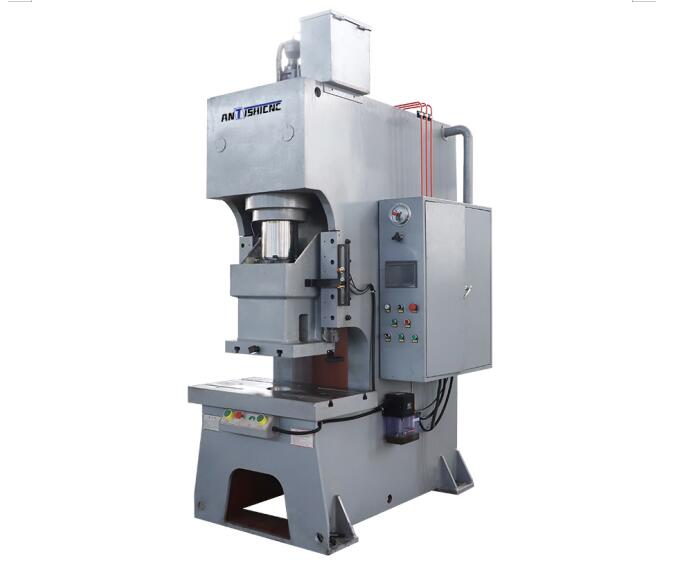
1. Core Hydraulic Punching Machine Technology: The Key Advantages of Antishi Products
A hydraulic punching machine is mechanical equipment that uses the reciprocating motion of a slide to apply pressure to metal sheets for processes such as punching, blanking, forming, and drawing. Its performance is largely determined by frame rigidity, transmission accuracy, operational safety, and automation compatibility. Antishi, with years of industry focus on user pain points, has produced hydraulic punching machines (represented by the flagship JC21 series mechanical hydraulic punching machine) with three core advantages that distinguish them from ordinary hydraulic punching machine products:
-
High Rigidity & High Precision: Utilizes a one-piece, special cast iron alloy frame that undergoes heat treatment to eliminate internal stress. Combined with a long slide guide design and a balancing device, it ensures long-term operation without deformation or chatter. Slide adjustment accuracy reaches 0.1mm, perfectly meeting high-precision processing requirements. Core components such as the crankshaft, gears, and transmission shaft are all hardened, heat-treated, and ground, offering excellent wear resistance for reliable long-term operation.
-
Safety, Efficiency & Easy Operation: Features a high-sensitivity clutch/brake combination unit, dual solenoid control valves, and an overload protection device, eliminating operational safety hazards. Supports both manual and electric slide adjustment for easy die setup. The open-back C-frame design allows three-sided operation, and the frame can be tilted 20°–25° to facilitate the slide-off of workpieces and scrap materials, making it suitable for automated feeding line retrofits and significantly improving production efficiency.
-
Full-Spec Range & High Cost-Effectiveness: The product line covers various tonnages from JC21-25T to JC21-100T, with nominal forces ranging from 250 kN to 1000 kN. Parameters such as slide stroke and worktable dimensions can be flexibly matched to different processing requirements. Compared to international brands, Antishi ensures performance while significantly reducing equipment procurement and operating costs, making it suitable for all scenarios, from small and medium-sized enterprises to large-scale manufacturing plants.
2. In-Depth Analysis of Industry Applications for Antishi Hydraulic Punching Machines
The application scenarios of hydraulic punching machines are closely tied to the processing requirements of metal sheets. Leveraging its full-spec product matrix and customization capabilities, Antishi has deeply penetrated nine core industries, achieving “one machine for multiple uses, precisely adapted.” Below, combined with the processing pain points of each industry, the application value of Antishi hydraulic punching machines is analyzed:
(1) Metal Sheet Processing Industry: Foundational Application, Efficient Empowerment
Metal sheet processing is the most fundamental application area for hydraulic punching machines, covering the processing of cold-rolled sheets, hot-rolled sheets, galvanized sheets, stainless steel sheets, aluminum sheets, and other materials. The core requirement is to efficiently complete various hole punching and basic forming operations for products such as enclosures, cabinets, kitchenware, and office furniture. The Antishi JC21 series hydraulic punching machine can precisely punch round holes, square holes, oblong holes, and special-shaped holes, as well as perform forming processes such as louvers, embossing, and trimming. The slide stroke rate can reach 45–60 times per minute, significantly improving processing efficiency. The worktable dimensions range from 400×600 mm to 500×900 mm, accommodating different sheet sizes. This solves the pain points of cumbersome die changes and insufficient processing accuracy found in ordinary hydraulic punching machines, making it the preferred equipment for small and medium-sized sheet processing enterprises.
(2) Automotive Parts Manufacturing: High-Precision Adaptation, Mass Production
The automotive industry demands extremely high precision, consistency, and production efficiency for parts processing, requiring large volumes of thin-sheet stamping, such as body brackets, connecting plates, chassis heat shields, and seat rail adjustment hole plates. Antishi hydraulic punching machines, with their high-precision transmission system and stable stamping performance, meet the requirements for multi-variety, high-volume production of automotive parts. Paired with a die library, they enable quick switching between different hole diameters and shapes without frequent die changes. Their high-rigidity frame prevents deformation during high-speed stamping, ensuring hole position accuracy and appearance consistency of parts, making them suitable for large-scale automotive parts production. Additionally, they can be equipped with automatic feeding devices to achieve fully automated production and reduce labor costs.
(3) Electrical Enclosure and Distribution Box Production: Precise Hole Control, Safe Adaptation
For products in the power industry such as distribution boxes, control cabinets, and instrument cabinets, the processing of enclosures requires strict hole position accuracy and appearance consistency, involving operations like switch holes, indicator light holes, ventilation louvers, and knock-out holes for cable entry/exit. Antishi hydraulic punching machines achieve precise hole control accuracy of 0.1 mm, perfectly matching the high-precision requirements of electrical enclosure processing and avoiding assembly issues caused by hole position deviations. Their stable operational performance ensures product consistency in mass production. The user-friendly frame design allows quick processing of electrical enclosures of different specifications, meeting the production needs of power equipment manufacturers and establishing these machines as core equipment in the electrical processing field.
(4) Home Appliance Enclosure Processing: Flexible Changeover, Adapting to Iteration
The home appliance industry is characterized by rapid product updates and diverse models. The core requirements are flexible production changeovers and efficient processing, such as stamping refrigerator side panels, washing machine shells, air conditioner outdoor unit housings, and microwave oven liners. Antishi hydraulic punching machines feature convenient die changes and, when paired with automatic programming software, achieve short changeover times, enabling mixed processing of various shapes and sizes—perfectly meeting the rapid changeover needs of the home appliance industry. Their high stamping speed and stable performance significantly improve the efficiency of appliance enclosure processing, while precise forming processes ensure the flatness and aesthetics of the enclosures, helping appliance companies enhance product competitiveness.
(5) Architectural Decoration and Curtain Wall Industry: Aesthetic Precision, Adapting to Customization
Products in the architectural decoration field, such as metal curtain wall panels, ceiling panels, partition boards, and decorative mesh panels, require processes like regularly arranged decorative punching, micro-hole processing for acoustic panels, and special-shaped cutting and flanging of aluminum panels, demanding high processing precision and visual aesthetics. Antishi hydraulic punching machines can precisely control hole diameters and spacing according to drawings, ensuring the overall visual effect of curtain walls. They can also accommodate decorative sheets of different thicknesses (0.5 mm to 6 mm), meeting the customized needs of the architectural decoration industry. Their high stability prevents issues such as sheet deformation and hole misalignment during processing, providing high-quality processing solutions for architectural decoration projects.
(6) Other Core Application Areas
-
Agricultural Machinery and Construction Machinery: Suitable for processing components such as tractor cab covers, harvester screens, and loader radiator guards. Antishi hydraulic punching machines offer strong processing capabilities, punching various hole types and reinforcing ribs on medium-thickness sheets, completing multiple processes in a single clamping to improve production efficiency.
-
Aerospace and Rail Transit: Used for high-precision components such as metal frames for aircraft interior panels, decorative panels for high-speed rail carriages, and enclosures for railway signaling equipment. The digital control advantages of Antishi hydraulic punching machines are fully realized, ensuring processing consistency and stability to meet the stringent requirements of these industries.
-
Environmental Protection and Ventilation Equipment: Processing dust collector housings, fan protective mesh covers, silencer perforated plates, and other products. Precisely controlling hole diameter accuracy and open area ratio ensures that equipment meets ventilation and sound insulation performance standards, adapting to the processing needs of the environmental protection industry.
3. Scientific Selection Guide for Antishi Hydraulic Punching Machines (Core Science Communication + Practical Recommendations)
The core principle of selecting a hydraulic punching machine is “matching requirements while balancing efficiency and cost.” Many companies face issues such as equipment overload, insufficient processing accuracy, and wasted capacity due to improper selection. Based on Antishi’s product characteristics and industry experience, a scientific selection plan is provided below from five core dimensions to help companies precisely match equipment and avoid selection pitfalls.
(1) Core Selection Dimension 1: Define Processing Requirements (Fundamental Prerequisite)
Before selection, three core requirements must be clarified to avoid blind decision-making:
-
Material and Thickness: Identify the metal sheet material (cold-rolled sheet, stainless steel sheet, etc.) and thickness. Antishi hydraulic punching machines are conventionally suitable for thin to medium sheets of 0.5mm–6mm, with some models capable of processing 6–8mm low-carbon steel sheets. Note that high-hardness materials (e.g., quenched steel sheets) or sheets exceeding the equipment’s maximum thickness are unsuitable for conventional hydraulic punching machines; customized solutions can be arranged by contacting Antishi.
-
Processing Technology and Precision: Clarify the core processing operations (punching, blanking, forming, drawing, etc.). If high-precision processing is required (e.g., for electrical enclosures or automotive parts), prioritize Antishi’s high-precision models to ensure hole position accuracy and forming quality. For general hardware processing, more cost-effective standard models can be chosen.
-
Production Capacity Requirements: Determine the required stroke rate and automation needs based on daily processing volume. The Antishi JC21 series offers a stroke rate of 45–60 times per minute. For high-volume production, automatic feeding devices can be added to achieve fully automated production and increase capacity.
(2) Core Selection Dimension 2: Tonnage Selection (Critical Parameter)
Tonnage is a core parameter of a hydraulic punching machine, representing the maximum pressure the slide can apply and directly determining processing capability. Selection must follow the principle of “precise calculation with reserved margin” to avoid insufficient tonnage or waste:
-
Tonnage Calculation Method: Refer to the stamping force calculation formula: P = T × L × K (where P = stamping force, T = material thickness in mm, L = stamping perimeter in mm, K = material shear strength in N/mm²). Additionally, consider the material holding force (approximately 30% of the stamping force). Forming processes require additional calculation of forming force.
-
Antishi Tonnage Selection Recommendations: Match tonnage reasonably based on processing requirements, reserving a 20% safety margin to avoid equipment overload and die damage. Specific recommendations are as follows:
-
Small-scale processing (thin sheets, small hole diameters): Choose JC21-25T (nominal force 250 kN) or JC21-40T (nominal force 400 kN). Suitable for processing small appliance parts and small hardware components.
-
Medium-scale processing (medium-thickness sheets, conventional hole shapes): Choose JC21-63T (nominal force 630 kN) or JC21-80T (nominal force 800 kN). Suitable for processing electrical enclosures, automotive parts, and architectural decorative panels.
-
Large-scale processing (thicker sheets, complex forming): Choose JC21-100T (nominal force 1000 kN). Suitable for processing agricultural machinery and construction machinery components.
-
(3) Core Selection Dimension 3: Equipment Parameter Matching (Detailed Key Points)
Beyond tonnage, parameters such as slide stroke, die height, and worktable dimensions of Antishi hydraulic punching machines must be precisely matched to the workpiece and die dimensions:
-
Slide Stroke: The distance from the slide’s top dead center to bottom dead center. It should be greater than twice the height of the stamped part to ensure smooth loading of the blank and removal of the finished part. The Antishi JC21 series offers slide strokes ranging from 80 mm to 130 mm, accommodating workpieces of different heights.
-
Die Height: The distance (adjustable) between the slide at bottom dead center and the worktable surface. It must match the die’s closed height to ensure normal operation after die installation. Antishi hydraulic punching machines offer die height adjustment ranges from 45 mm to 100 mm, providing flexible adjustment for different die specifications.
-
Worktable Dimensions: Must be larger than the horizontal dimensions of the lower die, with 50–70 mm reserved on each side for die installation. Antishi worktable dimensions range from 400×600 mm to 500×900 mm, accommodating workpieces of various sizes and meeting processing needs from small to large scales.
(4) Core Selection Dimension 4: Automation and Adaptability (Long-Term Benefits)
With the development of industrial automation, automation adaptability directly affects production efficiency and labor costs. Selection should consider your automation roadmap:
-
Basic Automation: All Antishi hydraulic punching machines support both manual and electric adjustment and can be paired with simple feeding devices to reduce manual labor intensity.
-
Full Automation: Models of 80T and above can be equipped with professional automatic feeding devices, featuring feed error detection, pre-cutting, and pre-break functions to achieve fully automated production, suitable for high-volume, large-scale processing.
-
Customized Adaptation: For special processing requirements (e.g., irregularly shaped parts, complex forming), Antishi offers customized modification services to adjust equipment parameters and structures for specific processing scenarios.
(5) Core Selection Dimension 5: Cost-Effectiveness and After-Sales Support (Risk Mitigation)
Selection should balance equipment performance and cost while also prioritizing after-sales support to avoid future operational issues:
-
Prioritize Cost-Effectiveness: Compared to international brands (such as Germany’s Dematic and Japan’s Komatsu), Antishi hydraulic punching machines achieve comparable precision and stability, but with 30%–50% lower procurement costs. Additionally, operating and maintenance costs are low, with a 1-year warranty on core components, significantly reducing upfront investment.
-
After-Sales Support: Antishi provides full technical guidance throughout the entire process—from selection and installation to commissioning and ongoing maintenance—with a professional after-sales team to promptly resolve any operational issues and ensure production continuity.
-
Avoiding Common Mistakes: Avoid the misconception that “higher tonnage is always better,” as excessive tonnage leads to energy waste and increased costs. Also, avoid neglecting precision requirements by using standard hydraulic punching machines for high-precision products, which leads to non-conforming output.
IV. Antishi Hydraulic Punching Machine: Empowering Industry Upgrades, Unlocking New Possibilities for Efficient Production
As a core piece of equipment in industrial manufacturing, the selection and application of a hydraulic punching machine directly impact a company’s production efficiency, product quality, and market competitiveness. Antishi Machinery Co., Ltd. remains committed to user-centric development, specializing in the R&D and production of hydraulic punching machines. With product advantages including high rigidity, high precision, and exceptional cost-effectiveness, we serve 9 key industries, offering a full range of specifications and scientifically based selection solutions to address your production challenges.
Whether you are a small or medium-sized hardware processing enterprise or a large manufacturer of automotive parts or electrical equipment, Antishi Machinery provides precise matching solutions and customized options to help reduce costs, improve efficiency, and strengthen your core competitiveness. Choosing Antishi hydraulic punching machines means choosing a stable, efficient, and reliable production partner, unlocking new possibilities in industrial manufacturing together!
Contact us:
Hotline: +86-1953403-1668
Email: contact@antsmachine.com
Our professional technical team provides one-on-one selection guidance and offers free customized processing solutions!