


In the world of heavy machinery machining, gantry milling machines, with their powerful milling capabilities, are the core force in shaping large workpieces—from the foundational components of wind turbines to the precision skeletons of aerospace vehicles. However, faced with a variety of configurations on the market, ranging from single-head to three-head, many decision-makers struggle with the choice: should they opt for the economical and practical single-head , the efficiency-first dual-head , or the ultimate automation of a three-head ? The number of milling heads is a core factor determining the machining capabilities, efficiency, and price of a gantry milling machine. The difference goes far beyond mere quantity; it represents a leap in capabilities from “general-purpose machining” to “high-efficiency mass production” and then to “complete machining . ” This article will delve into the core differences between various milling head configurations to help you find the “best partner” that perfectly matches your machining needs.
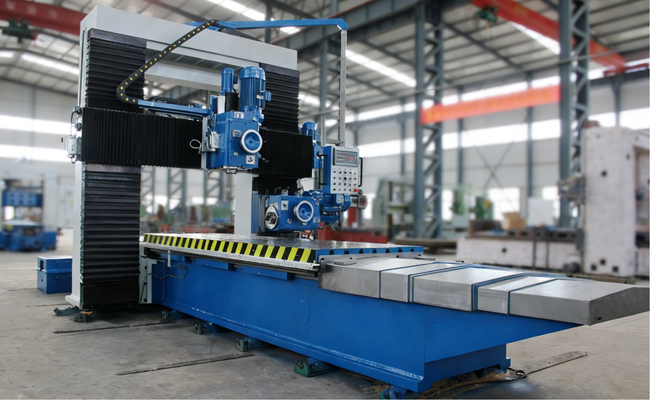
The table below visually illustrates the core differences between the three configurations:
| Comparison Dimensions | Single milling head | Dual milling head | Three-milling head |
| Core positioning | Flexibility first | Efficiency first | Integration/automation priority |
| Processing mode | One-time clamping, sequential processing. Processing one surface at a time. | One-time setup, collaborative machining. Two heads can simultaneously machine different parts of the same workpiece, or replicate two identical workpieces. | A single setup allows for machining on five sides. Typically, it uses two vertical milling heads plus one right-angle head, enabling machining of all surfaces of the workpiece except the bottom. |
| Core advantages | It has a simple structure, low investment cost, and relatively simple operation and programming. | Efficiency is doubled. It can achieve “simultaneous roughing and finishing” or “dual-station operation on one machine”, significantly reducing the processing time of a single workpiece. | It avoids multiple clamping and eliminates repeated positioning errors, making it particularly suitable for high-precision complex box-shaped and mold-type workpieces. |
| Production efficiency | Low. The machine tool has idle time during tool changing and positioning. | High efficiency. Through collaborative operation, machine tool idle time is greatly reduced, and efficiency is increased by 60%-150% compared to single milling heads. | It’s the best option. For complex workpieces, it eliminates the time spent on multiple hoisting and alignment operations, making its advantages revolutionary. |
| Applicable Scenarios | Multi-variety, small-batch, mold trial production, and repair workshop. | Components requiring high production volume and fast production cycle, such as wind turbine bases and equipment frames. | Complex workpieces requiring multi-faceted machining, such as aerospace structural components, engine cylinder blocks, and high-precision machine tool beds. |
| Cost considerations | It requires the least investment in equipment, but has a higher cost per unit. | The equipment investment is high, but the unit cost is significantly reduced, resulting in a high return on investment. | The equipment investment is the highest, and it is specifically used for high value-added and highly complex products. |
Key points for selection decision
The choice of configuration should not be based solely on the number of milling heads, but rather on your core needs:
1. Seeking flexibility to handle multi-variety, small-batch production?
Answer: A single milling head is the most cost-effective option.
2. Pursuing maximum production capacity through large-scale, rhythmic production?
Answer: Dual milling heads are key to improving efficiency and can quickly reduce equipment costs.
3. The objects to be processed are complex boxes and molds, and the requirement is to complete all processing in one clamping operation?
Answer: Three milling heads are the best solution to ensure accuracy and avoid errors from multiple clamping operations. Although the initial investment is the highest, the total cost may be lower for a specific workpiece.
The following are the parameters for the Anticipation dual-head small gantry milling machine:
| Specification | unit | X2010*2m | X2010*3m | X2010*4m | |||||
| X axis travel | mm | 2000 | 3000 | 4000 | |||||
| Y axis travel | mm | 1300 | |||||||
| Z axis travel | mm | 1000 | |||||||
| Beam movable distance (up and down) | 840 | ||||||||
| Table dimensions | mm | 2000×1000 | 3000×1000 | 4000×1000 | |||||
| T-slots(number*width*spacing) | mm | 7×22×125 | |||||||
| Spindle nose-to-table distance | mm | 200—1040 | |||||||
| Table load capacity (max.) | kg | 2000 | 3000 | 4000 | |||||
| X axis rapid feed | mm/min | 1360 | |||||||
| Y axis rapid feed | mm/min | 890 | |||||||
| Z axis rapid feed | mm/min | 730 | |||||||
| Work feed X axis | mm/min | 0—1360 | |||||||
| Work feed on Y axis | mm/min | 65/320/890 | |||||||
| Work feed on Z axis | mm/min | 50/265/730 | |||||||
| Speed range | rpm | 82—505((Level 6)) | |||||||
| Torque (max.) | Nm | 790 | |||||||
| Spindle mount | ISO 50 | ||||||||
| Head swivel range | ±35° | ||||||||
| Spindle taper step | 7:24 ISO50 | ||||||||
| Rate of milling head | mm | (Along the cross rail):65/320/890
(Side milling head):50/265/730 |
|||||||
| Motor rating-headstock | kW | 7.5 | |||||||
| X axis | kW | 4 | 5.5 | 7.5 | |||||
| Y axis | kW | 1.1 | |||||||
| Z axis | kW | 4 | |||||||
| Dimensions | mm | 4550×3200×2550 | 6550×3200×2550 | 8550*3200*2550 | |||||
| Weight | kg | 10000 | 18000 | 21000 | |||||
ANTISHICNC is a professional milling machine manufacturer. If you have any milling machine needs, please contact the ANTISHICNC team. We have extensive production and processing experience and can recommend the most suitable milling machine for your products, provide appropriate usage advice, and offer professional technical support. We mainly offer CNC milling machines and conventional milling machines. If you have CNC lathe production needs, please contact ANTISHICNC :contact@antsmachine.com
Keywords: gantry milling machine, milling machine, multi-face milling