


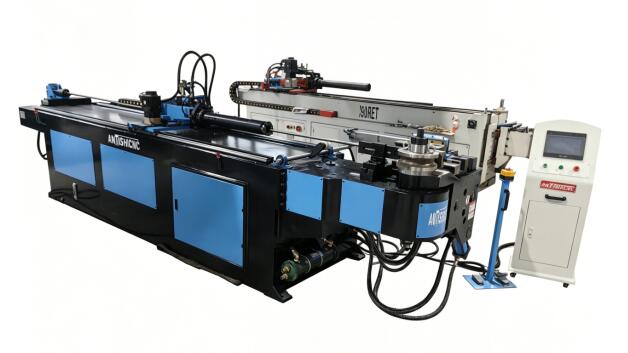
The main advantages of servo motor control lie in its precision, speed, and energy efficiency; while the advantages of hydraulic cylinder control are reflected in its high output, low cost, and durability. The two are not simply substitutes for each other, but rather each has its own emphasis depending on the application scenario and process requirements.
Comparison of main control methods
| Characteristics | Servo Motor Control | Hydraulic Cylinder Control |
| Principle | Composed of servo drives, motors and encoders to form a closed-loop system, achieving precise control of position, speed and torque. | Using hydraulic oil as the medium, the oil pump and valve group drive the cylinder piston to move, generating power. |
| Accuracy | Extremely high. Repeat positioning accuracy can reach ±0.05°, with minimal impact from external environments. | Relatively low. Accuracy is easily affected by factors such as oil temperature changes, hydraulic oil quality, and valve response. |
| Efficiency | High. The servo motor responds quickly, no need to wait for hydraulic pressure to build up. The overall efficiency is more than 50% higher than that of hydraulic systems. | Relatively low. It requires waiting for the oil pressure to build up, resulting in a relatively slow speed. |
| Energy Consumption & Environmental Protection | Excellent. The servo motor “works on demand”, saving more than 50% energy compared to hydraulic systems, with no waste oil pollution and low noise (approx. 55-60 dB). | Poor. The oil pump runs continuously, resulting in high energy consumption and large system heat generation. It requires regular hydraulic oil replacement (approx. 200-300L/year) and waste oil disposal. |
| Output Power | Relatively small. Suitable for small and medium pipe diameters; costs increase significantly when high output power is required. | Very large. Naturally suitable for bending large-diameter and thick-walled pipes, with stable and powerful output. |
| Cost | High. High costs for hardware, systems and maintenance; core components rely on high-end brands. | Low. Mature technology with relatively low costs, it is the mainstream choice in the market. |
| Maintenance | Simple. Compact structure with minimal daily maintenance workload, but high repair costs in case of failure of core components such as servo drives. | Complex. Requires regular replacement of hydraulic oil, filter elements, and inspection of seals and valve groups; maintenance workload is large. |
Typical Application Scenarios
Servo Motor Control: Used for high-precision, complex-shaped pipe processing in aerospace, automotive manufacturing, and medical device industries, as well as for small-diameter mass production in electronic equipment where efficiency and consistency are critical.
Hydraulic Cylinder Control: Used in applications requiring large-diameter, thick-walled pipe bending, such as steel structures, large-scale pipeline projects, and shipbuilding, as well as in general industrial and furniture manufacturing where budgets are limited and precision requirements are lower.
Hybrid Systems: The Mainstream Choice
In practical applications, pure servo or pure hydraulic cylinder systems are not the only options. Currently, many machines on the market use hybrid systems. High-precision actions such as core positioning and feeding are driven by servo motors, while auxiliary actions such as clamping and mandrel extension/retraction are performed by hydraulic or pneumatic cylinders. This approach strikes a good balance between precision and cost.
Furthermore, from a mechanical perspective, the power of the servo motor needs to be transmitted to the actuator through a specific transmission method. Common transmission methods include:
Rack and pinion: Commonly used in semi-automatic NC machines, with generally lower precision and susceptible to backlash.
Sprocket and Chain: Simple structure, economical cost, and relatively high precision in CNC servo machines.
Hardened connecting rods: Extremely high precision, achieving 0~195° without dead points, but requiring high precision in machining and design.
Bevel helical gears: Compact structure, reducing the size of the machine head, and offering high precision.
Summary: Trends and Selection Recommendations
As the manufacturing industry upgrades towards intelligent and green technologies, all-electric servo pipe bending machines are a clear future development direction. They are penetrating from the high-end market downwards, while pure hydraulic equipment remains more focused on specific areas requiring cost sensitivity or high output.
Selection Recommendations:
Prioritize Servo Motor Control: If your product has high requirements for precision, efficiency, and consistency, or if you plan to build an automated production line.
Hydraulic Cylinder Control Remains a Practical Choice: If the processing task involves large-diameter, thick-walled pipes, and the budget is limited with lower precision requirements.
Evaluate Hybrid Systems on Demand: This is currently the most common choice in industry, striking a good balance between performance and cost.
If you also need a suitable pipe bending machine, please feel free to consult Shanghai ANTISHICNC Machine. As a seasoned supplier of metal machining equipment, we have rich experience in mechanical equipment manufacturing and application, and can provide you with professional technical support.
Please send an email to: contact@antsmachine.com
For more product information, please visit: https://www.antsmachine.com/
Keywords: