


The “push-bending function” and “rear push-pull function” of a pipe bending machine are two different working modes. The core difference is that push-bending is an independent pipe bending process, while rear push-pull is an auxiliary technology.
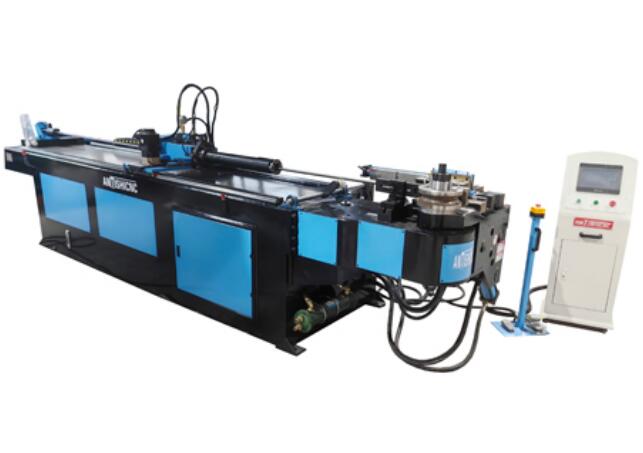
Main Structural Differences and Force Principles
Push-Bending Function (Side Assist Push)
- Installation Position: Closely attached to the side of the bending die’s cutting point, locally supporting the pipe on the outer side of the bend;
- Force Direction: Perpendicular to the pipe’s axis, acting only on the deforming localized bending area;
- Power Shaft: Independent servo-assisted push shaft, synchronously interpolating with the bending rotation shaft;
- Working Principle:Synchronously pushes forward during bending, supporting the outer wall of the pipe, counteracting pipe wall stretching and inner material accumulation during bending, and inhibiting wrinkles and collapse.
Rear Push Function (Tail Axial Assist)
- Installation Location:The clamping end of the feeding trolley at the tail of the machine, at the very end of the entire pipe;
- Force Direction: Applying continuous axial thrust forward along the entire axis of the pipe;
- Power Source:Utilizing the X-axis servo for thrust, following the bending feed throughout the entire process;
- Working Principle:Compensating for the stretching amount from the tail of the pipe forward, reducing the average thinning rate of the entire pipe wall, and improving the tensile deformation of large arcs and thick pipes.
Key performance comparison
| Comparison Dimension | Push Bending (Side Auxiliary Push) | Rear End Thrust Bending (Tail Full Assistance) |
| Force Bearing Range | Only the curved arc section bears local force | The entire pipe bears axial force throughout the bending process |
| Anti-wrinkle Performance | Excellent; specially designed to eliminate wrinkling for small pipes and small R radii | Average; mainly used to reduce wall thickness thinning |
| Pipe Length Requirement | No restrictions; applicable to short workpieces and pipes without extra tail allowance | Extra clamping length must be reserved at the pipe tail; not suitable for short workpieces |
| Applicable Pipe Wall | Thin-walled pipes, ultra-thin stainless steel / copper tubes | Thick-walled steel pipes, large-diameter heavy-duty pipes |
| Suitable Bending Radius | Small R bending (R≤1.5D) | Large-radius gentle arcs, long straight pipe parts |
| Thrust Force Magnitude | Medium & fine adjustable thrust with precise control | Heavy-duty high thrust for material compensation |
| Multi-bend Machining | Supports continuous multiple bends without interference | Insufficient tail clamping allowance easily occurs during multiple bends |
Processing Scenarios
Application Scenarios for Push-Bending (Side-Assisted Push):
- Thin-walled pipe fittings with small bending radii: Air conditioning copper pipes, hydraulic precision stainless steel oil pipes, and aerospace thin pipes. Bending radii ≤ 1.5 times the pipe diameter are prone to wrinkling and inner wall collapse. Side-assisted push supports the curved surface to ensure roundness.
- Short pipe fittings and workpieces with insufficient tail length: The total length of the part is short, and there is insufficient clamping space at the rear end, making it impossible to open and push. Side-assisted push is the only way to prevent deformation.
- High-precision clean piping: Medical device piping and hydraulic precision connectors require a non-elliptical cross-section and wrinkle-free inner wall after bending to ensure smooth fluid flow.
- Small parts with multiple continuous bends:Dense bends and segmented bends cause the rear clamping space to be occupied by the previous bend, preventing rear-pushing from working. Side-assisted push is unaffected.
Rear-pushing (tail-assisted pushing) application scenarios:
- Thick-walled, large-diameter pipes:Hydraulic steel pipes for engineering machinery, exhaust pipes, thick-walled iron pipes for guardrails. Due to large wall stretching, axial pushing reduces overall thinning, preventing pipe wall cracking.
- Long profiles, large-radius, gently curving arcs:Handrails, long arc-shaped pipes for vehicle frames. The entire pipe experiences uniform stretching deformation; continuous thrust at the tail compensates for the total stretching.
- High-strength, rigid pipes:Alloy steel pipes, thick carbon steel. Due to their high rigidity, small side thrust is insufficient to offset the stretching; a large thrust at the rear is required for auxiliary forming.
- Single long arc, single bend workpieces: Sufficient clamping length is reserved at the tail of the workpiece, eliminating interference from multiple bends and pursuing uniform overall wall thickness.
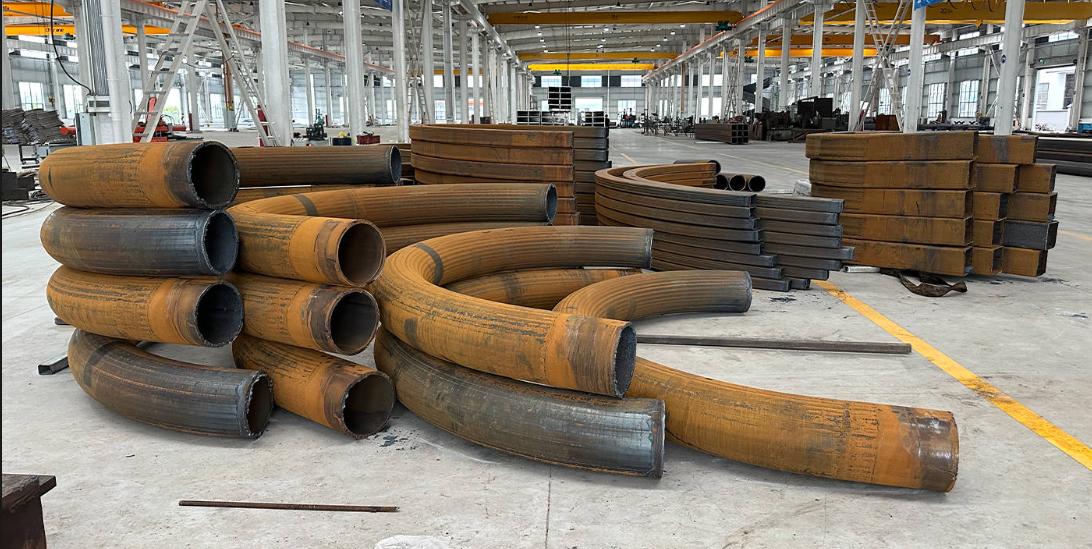 |
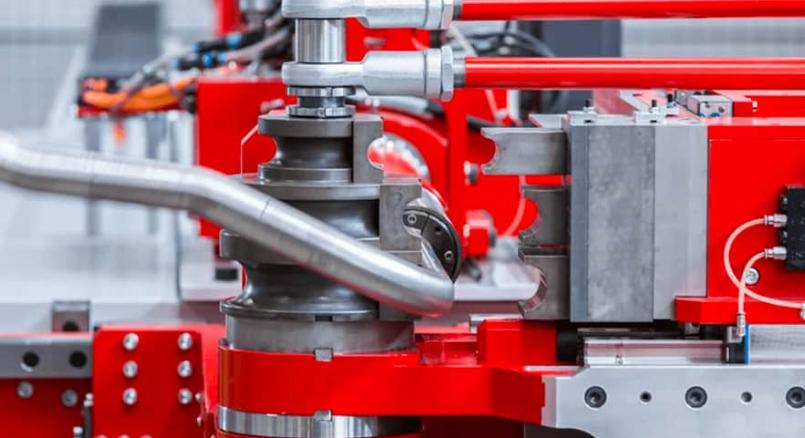 |
| push-bending |
rear push-pull |
Some high-end CNC pipe bending machines can simultaneously operate two functions: for small-radius, thin-walled, thick-length pipes, side-assisted push for wrinkle prevention and rear push for thinning reduction provide dual compensation, resulting in optimal processing quality; for short parts and small bends, only side-assisted push is used; for thick-walled, long single bends, only rear push is used.
Summary:
- Push Bending (Side-Assisted Push):Supports the curved section locally against the side of the bending die → suitable for thin-walled, small-radius, short materials, and multiple bends, primarily for wrinkle prevention and maintaining roundness;
- Rear Push: Pushes the entire pipe forward from the tail end → suitable for thick-walled, large-diameter, long materials, and large arcs, primarily for overall compensation of stretching and reducing pipe wall thinning.
If you also need a suitable pipe bending machine, please feel free to consult Shanghai ANTISHICNC Machine. As a seasoned supplier of metal machining equipment, we have rich experience in mechanical equipment manufacturing and application, and can provide you with professional technical support.
Keywords: