


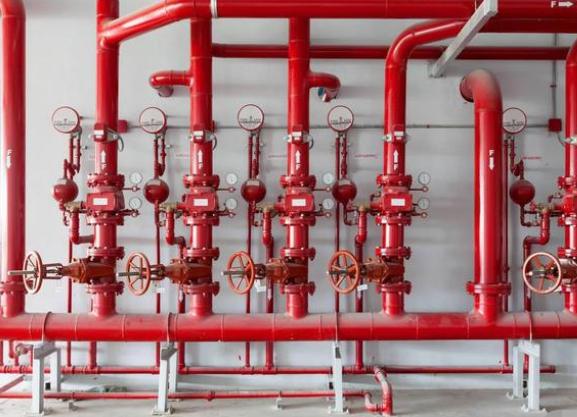
Connected pipe nozzles in fire-fighting pipelines, which must meet the requirements of reliable sealing, stable flow rate, and qualified connection strength. Their processing involves key links such as thread forming, sealing surface machining, and flow channel forming. Pipe threading lathes, with their high-precision thread processing capabilities and the advantages of dual-chuck and tailstock centering, are suitable for the small-to-medium-batch production of fire-fighting nozzles (especially for nozzle types with pipe thread connections, such as NPT, G, R, and other standard threads).
 |
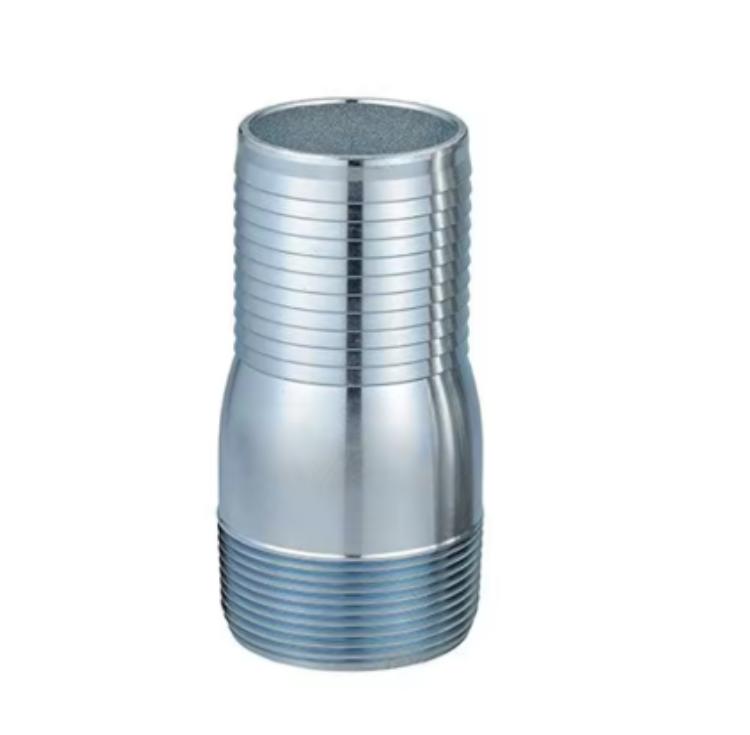 |
Common key features of fire-fighting nozzles include connecting threads and sealing surfaces:
- Connecting threads: Must comply with fire-fighting pipeline standards (e.g., domestic standards GB/T 7306.1-2008 55° BSP Parallel (BSPP) sealing pipe threads, GB/T 12716-2011 60° tapered pipe threads (NPT); international standards ISO 7/1, BSPP, etc.). The thread precision is usually required to be 6H/6g to ensure leak-proof sealing.
- Sealing surfaces: Thread end faces or tapered surfaces (e.g., 1:16 tapered sealing surfaces) must have a flatness of ≤0.01mm and a surface roughness of Ra≤1.6μm to prevent water leakage under pressure.
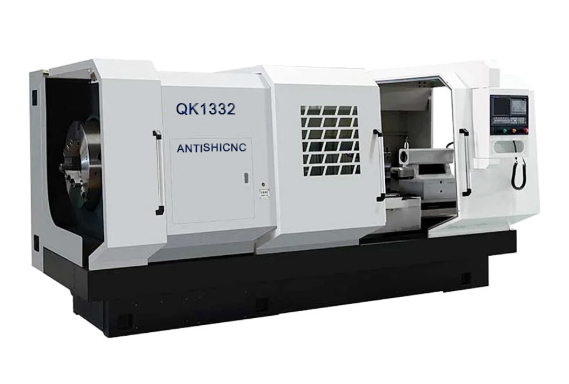
To meet the above thread requirements, Shanghai ANTISHICN Company selects the CNC QK1332 pipe threading lathe for customers. This lathe can process fire-fighting pipelines with a maximum diameter of 1000mm, a bore diameter of 330mm, and a length of 6m. It supports automatic thread programming and constant surface speed cutting, ensuring higher precision.
The basic processing flow of straight-stream water nozzles using the QK1332 CNC pipe threading lathe is as follows:
- Facing: Use an external turning tool to machine the sealing surface, ensuring an end face perpendicularity of ≤0.01mm to avoid poor fitting of the thread sealing surface.
- Rough turning of external diameter: Turn the main external diameter of the nozzle according to the drawing dimensions, leaving a finishing allowance of 0.2-0.3mm (for brass) or 0.3-0.5mm (for stainless steel) to prevent deformation during subsequent finishing.
- Rough boring of inner hole/flow channel: Use an internal turning tool to machine the through hole of the flow channel, leaving a finishing allowance of 0.1-0.2mm. The inner hole cylindricity must be ≤0.015mm to prevent water flow deviation.
- Rough turning of thread external diameter: Turn the pre-threading surface according to the thread major diameter dimension, leaving a thread machining allowance of 0.1-0.15mm. For example, the major diameter of an NPT 1/2 thread is 21.335mm, so rough turning should be performed to 21.5mm.
- Finish turning of external diameter and sealing surface: Finish-turn the external diameter to the drawing dimensions (tolerance: ±0.02mm) and chamfer to avoid sharp edges scratching the seal. Finish-turn the sealing end face (i.e., the rear side of the thread) to a flatness of ≤0.01mm and a surface roughness of Ra≤1.6μm (a dial indicator can be used to detect end face runout to ensure perpendicularity to the thread axis).
Model: QK1332 CNC Pipe Threading Lathe
| Specifications | Units | QK1332 |
| Maximum turning diameter over the bed | mm | Φ1000 |
| Maximum workpiece turning diameter over the cross slide | mm | Φ610 |
| Maximum workpiece diameter (short disc) | mm | Φ900 |
| Machined pipe thread diameter (outer diameter) | mm | 190-320 |
| Maximum workpiece length (outer diameter) | mm | 6000 |
| Bed guideway span | mm | 755 |
| Spindle bore | mm | Φ330 |
 |
||
If you are also interested in fire-fighting pipe threading, please click the link below to view product details: Welcome your inquiries!
Keywords: lathe, CNC lathe, pipe threading lathe, CNC pipe threading lathe, thread turning