


The four-column hydraulic press machine is heavy-duty forging and pressing equipment that uses hydraulic oil as the working medium, transmits pressure using Pascal’s principle, and uses four columns as guiding and force-bearing components to perform pressing, stretching, bending, punching, forming, and other processing on workpieces. It is one of the most widely used types of hydraulic press machine in industrial production.
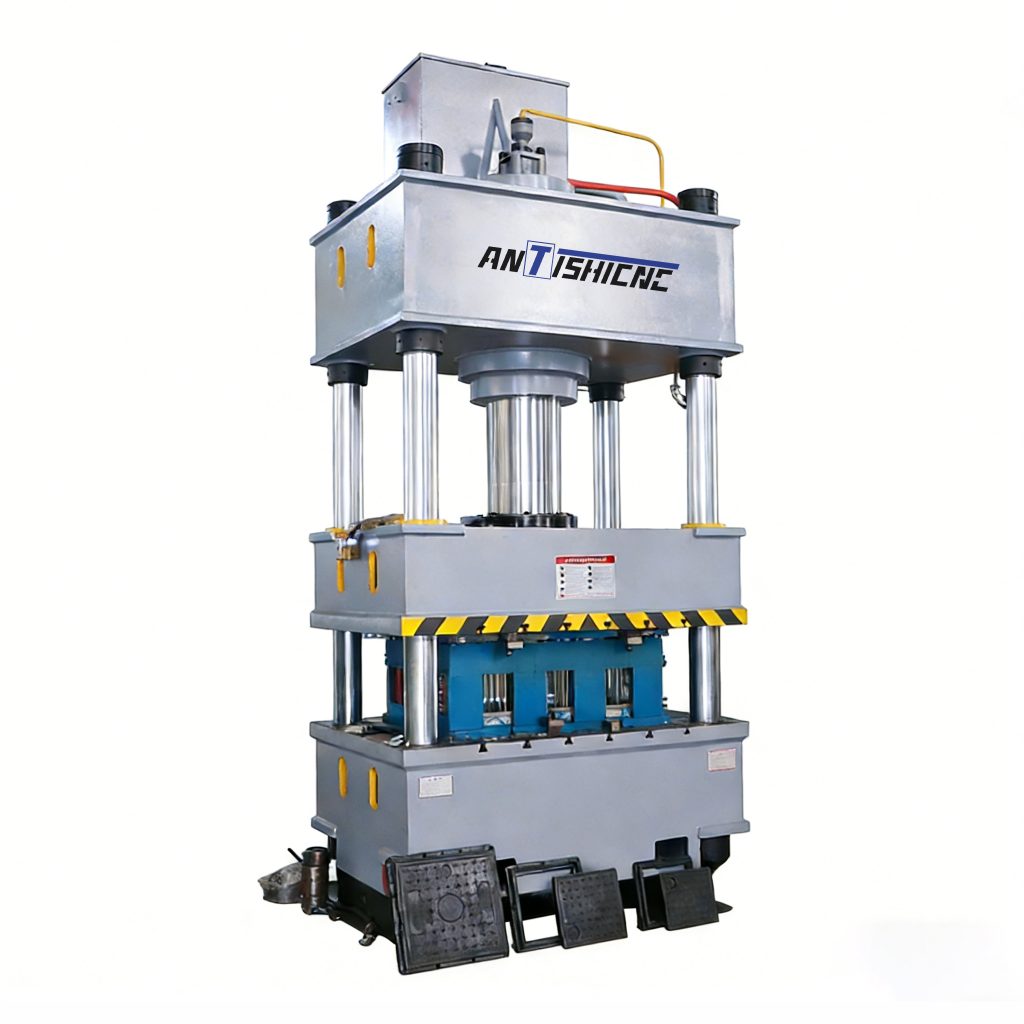
Its core structure consists of five main parts: four columns (guide columns), an upper crossbeam, a lower crossbeam (worktable), a slider, and a hydraulic system. The four columns are symmetrically distributed, running through theupper and lower crossbeams and secured with nuts, forming a stable frame structure that ensures the guiding accuracy of the slider’s vertical movement. The slider, driven by a hydraulic cylinder, reciprocates along the columns, working in conjunction with the lower crossbeam worktable to apply pressure to the workpiece placed on the worktable, completing various processing steps.
Compared to other types of hydraulic presses, the four-column hydraulic press machine offers advantages such as structural stability, uniform force distribution, high guiding accuracy, and a wide processing range. Pressure, stroke, and speed can be adjusted according to processing needs, making it suitable for processing everything from small parts to large plates and profiles. It is widely used in various industrial fields such as hardware processing, automotive parts manufacturing, aerospace, building materials, and mold processing.
Four-column hydraulic press machine commonly come in two structural forms: single-cylinder and double-cylinder. What are the specific differences between them? Below, engineers from Shanghai ANTS Machine Equipment Co., Ltd. will analyze this for you.
| Item | Single-cylinder | Double-cylinder |
| Picture for reference | 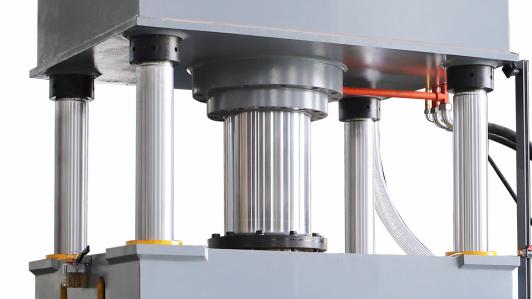 |
 |
| Structure and Working Principle | The hydraulic press machine has only one main cylinder mounted at the center of the hydraulic press machine crossbeam, with the piston rod moving downward to apply pressure.
The structure is simple and power transmission is direct, but pressure is concentrated at the central point. |
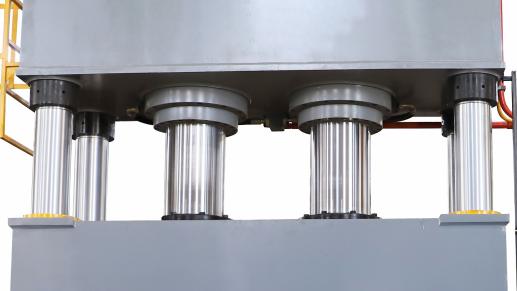
The hydraulic press machine has two hydraulic cylinders that are typically arranged symmetrically on both sides of the upper crossbeam (or configured as a main cylinder plus auxiliary cylinder combination).
This provides more uniform pressure distribution and enables complex movements through coordinated control (such as offset load adjustment). |
| Off-Center Load Capacity | Poor performance; prone to slider tilting and guide rail wear under uneven loading. | Enhanced performance with dual-cylinder synchronous control accommodates partial load conditions. |
| Stability | The machine applies pressure through the center of the hydraulic press machine, requiring a high degree of symmetry. | The hydraulic press machine applies pressure at multiple points, resulting in smoother ram operation. |
| Precision Control | Generally suitable for applications with low precision requirements. | Higher precision achieved through dual-cylinder closed-loop control to guarantee parallelism. |
| Maximum Tonnage | Typically used for small to medium tonnage operations. | Ideal for heavy-duty applications with distributed loads. |
| Space Utilization | Pressure concentration in the center of the workbench area with low peripheral utilization. | Uniform force distribution across the worktable facilitates large-area machining. |
| Application Scenarios | Suitable for conventional processes such as small-part stamping, press-fitting, and straightening. | Suitable for forming large workpieces. |
| Cost and Maintenance | Low | High |
The 200-ton four-column hydraulic press machine features a single-cylinder, three-beam four-column structure with a hydraulic system employing a two-way cartridge valve integrated system. The machine’s control system offers both manual and semi-automatic operating modes. It supports pressure limiting, stroke limiting, positioning, and process actions. The machine is equipped with a dual-circuit electric heating system.
| Description | YQ32-200T |
| Maximum liquid pressure (Mpa) | 25 |
| Slider stroke (mm) | 600 |
| Maximum opening height (mm) | 1000 |
| Table size (mm) | 800×800 |
| Down speed of empty range (mm/S) | 110 |
| Working speed (mm/S) | 6-12 |
| Return speed (mm/S) | 100 |
| Motor power (kw) | 11 |
| Oil pump displacement (ml/R) | 63 |
| Jacking force (t) | 50 |
| Ejection stroke (mm) | 250 |
| Machine size (L*W*H) (mm) | 1450*1000*3900 |
| Pump station size (L*W*H) (mm) | 1200*1300*1700 |
| Weight (T) | 4 |
Remark: The above parameters are for reference only, the actual parameters of the machine please refer to the technical program of Shanghai ANTISHICNC.
If you have the hydraulic machine needs too, welcome to consult Shanghai ANTS Machine Equipment co., ltd. We have rich experience in manufacturing and using hydraulic press machine and can provide you with professional technical support.
Keywords: hydraulic press machine, four-column hydraulic press machine, 200-ton hydraulic press machine