Generally, CNC lathes mainly have the following configurations:
- Horizontal
- Vertical
- Slant bed
- Flat bed
- Standard
- Multi-axis
Other types, such as Swiss type, multi-axis type, B-axis type
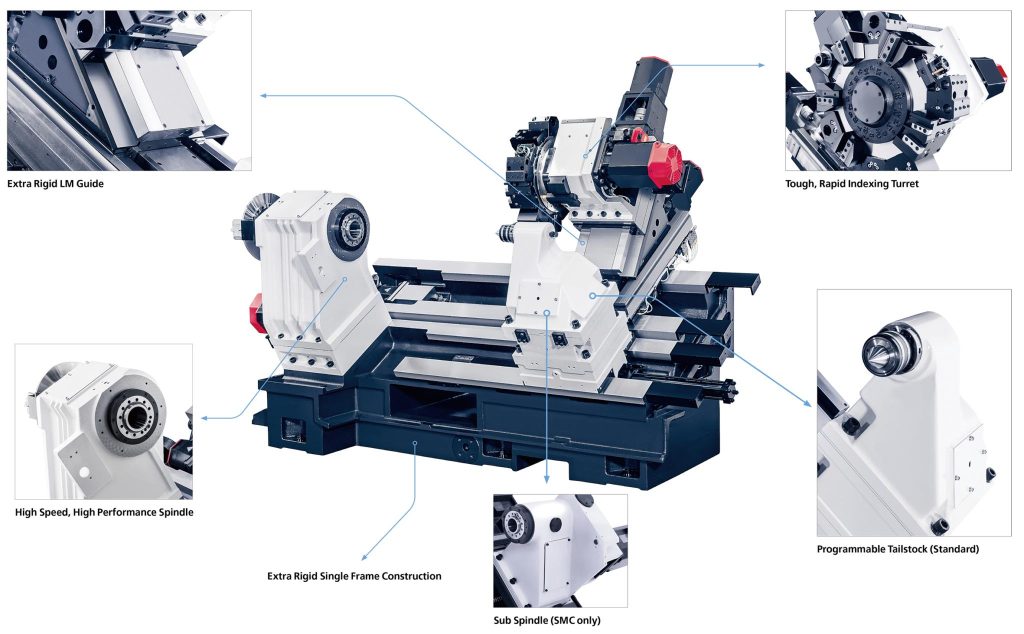
Depending on the configuration, a CNC lathe may contain the following components:
Bed:
The bed of a CNC lathe or CNC turning center is the main foundation of the entire machine. All the machine’s components are mounted on the bed. For example, the spindle box houses the machine spindle; the tailstock; the X-axis and Z-axis slides; an optional Y-axis; and the sub-spindle.
To ensure the machine tool’s service life, ANTS uses high-quality Meehanite cast iron to manufacture the machine tool bed. This helps reduce thermal deformation and provides robust mechanical stability, thus ensuring that machined parts always maintain high precision.
Spindle:
The spindle is often referred to as the core component of the machine tool. It consists of the spindle assembly and the spindle drive system. These components are the moving parts of the CNC machine tool, including the motor, gears, and chuck. The C-axis drive unit for workpiece positioning is also assembled with the spindle.
The tool turret is typically mounted on a turret (a rotating disc used for positioning and changing tools), including fixed and lifetime tool turrets. The lifetime tool turret drive system is built-in.
To ensure higher quality, ANTS manufactures 100% of its spindles and components in-house. Depending on the application requirements, these spindles can withstand standard or higher selectable speed ranges and operate with minimal vibration.
Subspindle/Second Spindle:
The subspindle can be used as an optional accessory, operating independently of the main spindle and synchronously with it to complete the first and second cutting operations on a CNC lathe. This improves machining efficiency and throughput. When used as a second spindle, its machining capacity and power are the same as the main spindle.
Chuck:
A chuck is a vise-like structure used to clamp the workpiece to be machined. It is attached to the spindle, which drives the chuck and workpiece to rotate together.
To improve productivity, you should consider using a CNC lathe that offers a variety of options to select the appropriate tools for different turning operations. Huachuan’s machine tools offer sufficient flexibility and size to meet the needs of machining extra-long tubing and other long-shaft applications.
Guideways:
Guideways allow the tool to move horizontally and vertically, enabling a smooth cutting process. To ensure durability, this structure requires high rigidity and extremely high precision.
ANTS machine tools utilize highly rigid solid box-type guideways on all axes to reduce intervals between operations and improve machining accuracy.
Spindle Box:
The spindle box consists of the main motor and the spindle, on which a chuck is mounted. To ensure high performance, you need to consider whether the machine tool’s spindle box can withstand high torque at low speeds. This is especially important for machining hard materials.
ANTS employs a gear drive system, providing powerful and stable performance. The drive components and spindle motor are also carefully designed to effectively reduce heat and vibration transmission.
Tailstock:
The tailstock provides additional support at the other end of the workpiece. This is necessary when machining long and extra-long workpieces, such as shafts.
Antishi tailstock is programmable for semi-automatic positioning. This allows for more robust support and higher precision for machined parts.
Turret:
The turret is used to change the cutting tools required for machining and is therefore mounted on a tool turret. The size of the turret depends on the number and size of the tools mounted on it.
To ensure machining stability and accuracy, ANTS turrets provide strong clamping force and a positioning time of 0.2 seconds/set, enabling fast and more stable machining.
Optional options include:
- CNC lathe Y-axis (for eccentric machining)
- CNC lathe parts collector (automatic part unloading)
- CNC lathe bar feeder/bar bin (bar feeder for single bars, while bar bin for automated machining involving multiple bars).
- Subspindle
- MC drive including milling, lifetime tooling, and C-axis operation
- Multiple bed lengths to meet the needs of long spindles or pipework