


In CNC machining, 3+2 five-axis and 5-axis linkage are two completely different working modes. The core difference lies in whether the rotary axis and the linear axis interpolate simultaneously, which directly determines the machining range, accuracy, efficiency and price.
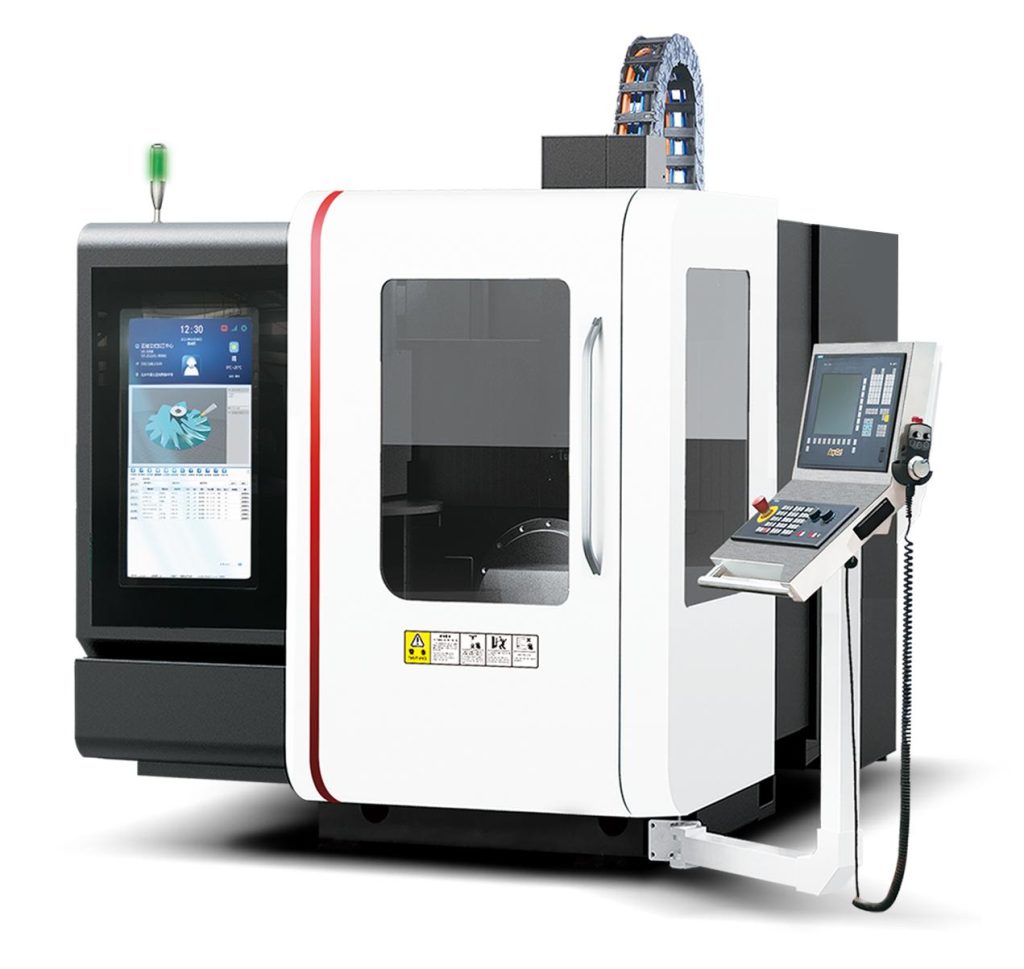
Key Concept Distinctions:
1. Five-Axis Machining Center (usually referring to a 5-axis simultaneous machining center)
Essence: A machine tool’s five motion axes (X, Y, Z linear axes + A/B, B/C rotary axes) can move simultaneously and coordinately under the control of a CNC system to perform continuous cutting.
Key: Simultaneous Movement. The tool direction and working position continuously and dynamically change during machining to maintain the optimal cutting angle.
Analogy: Like carving a complex, twisted shape with a knife, your wrist and fingers (equivalent to the rotary axes) need to constantly rotate with the curved surface to ensure the cutting edge always contacts the material at the optimal angle.
2. 3+2 Five-Axis Machining Center (essentially an enhancement of a three-axis machining center)
Essence: It utilizes two rotary axes of a five-axis machine tool to rotate and fix the workpiece at an inclined angle, then uses traditional three-axis simultaneous movement (X, Y, Z) for cutting.
Key: Positioning. First, “set the position” (the “2” in 3+2 is responsible for positioning), then “carve linearly” (the “3” in 3+2 is responsible for machining). During a single cutting operation, the rotary axis remains locked.
Analogy: Imagine you first tilt and fix a wooden block on an angled worktable, then use a three-axis CNC engraving machine (which can only move up, down, left, right, forward, and backward) to process it. Want to process another side? Then stop the machine, readjust the angle of the wooden block, fix it again, and perform three-axis processing again.
Key differences comparison
| Features | 3+2 Five-Axis Machining (Positioning Five-Axis) | 5-Axis Simultaneous Machining (True 5-Axis) |
| Main Principles | Indexing and positioning, three-axis cutting | Synchronous 5-Axis, Continuous Cutting |
| Axis Motion | During machining, two rotary axes are locked, only the XYZ three axes move in tandem. | During machining, all five axes (XYZ + two rotary axes) can move simultaneously. |
| Main Advantages | 1. Low cost: Lower requirements for machine tools and CNC systems.
2. High rigidity: With the rotary axes locked, it functions like a rigid worktable, allowing for large cutting depths. 3. Simple programming: Mature three-axis CAM software and programming strategies can be used. 4. Capable of machining complex angles: Solves the problem of three-axis machine tools being unable to machine inclined surfaces and side holes. |
1. Machining Complex Surfaces: Such as impellers, turbines, propellers, precision molds, and other non-developable continuous curved surfaces.
2. One-Time Clamping: Completes machining of all surfaces, avoiding repeated positioning errors. 3. Improved Efficiency and Surface Finish: Through side-cutting milling and tool center point control, machining can be performed with shorter tools, higher linear speeds, and constant cutting conditions, improving quality and efficiency. 4. Interference Avoidance: Dynamically adjusts the tool axis direction to avoid collisions with the workpiece or fixture. |
| Limitations | 1. Cannot machine complex free-form surfaces.
2. Lower efficiency: Multiple positioning and clamping are required for multi-angle features. 3. Cumulative errors: Multiple re-clamping may introduce errors. |
1. High Cost: Requires highly skilled machine tools, CNC systems, CAM software, maintenance, and operators.
2. Complex Programming: Requires advanced 5-axis simultaneous CAM software and professional programming engineers. 3. Relatively Weak Cutting Rigidity: During dynamic rotation, rigidity is lower than in a locked state. |
| Typical Applications | 1. Holes, inclined surfaces, and cavities at different angles on polyhedral parts (such as mold cores, valve bodies, and housings).
2. Workpieces requiring high-quality milling at specific angles. 3. Five-axis machining processes that do not have high requirements for complex curved surfaces. |
1. Aerospace components: Aircraft structural parts, engine bladed disks/impellers.
2. Energy industry components: Steam turbine blades, water turbine blades. 3. High-precision complex molds: Automotive body panel molds, medical device molds. 4. Complex artificial bones, dentures. |
| Machine Tool Structure | Common forms include double pendulum tables, single pendulum tables + single pendulum head, etc. | Diverse structures, such as double-swivel heads, single-swivel head + single-swivel stage, double-swivel stage (high performance), etc. The key lies in the system’s linkage capability. |
. If you primarily machine housings, valve bodies, multi-sloped surfaces, and angled holes, prioritizing cost-effectiveness, rigidity, and ease of operation, a 3+2 five-axis machining center is sufficient.
. If you need to machine impellers, blades, complex molds, or aerospace curved parts, requiring single-clamping and guaranteed surface accuracy, choose a 5-axis simultaneous machining center.
. If you can tell me the types of parts you primarily machine, their materials, and precision requirements, I can help you determine whether a 3+2 or simultaneous five-axis machining center is more suitable.
If you also need a suitable 5-axis machining center, please contact Shanghai ANTISHICNC Machine. We are a seasoned supplier of metal machining equipment with extensive experience in mechanical equipment manufacturing and application, and can provide you with professional technical support.
Please send an email to :contact@antsmachine.com;
For more product information, please visit: https://www.antsmachine.com/
Keywords: Machining center; 5-axis machining center; VMC